
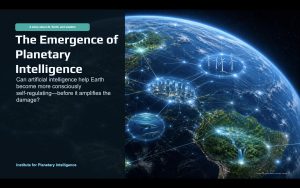
A genuinely superior intelligence would not merely calculate more efficiently than humans; it would understand more deeply the conditions that make intelligence, meaning, beauty, novelty, and relationship possible. If that is true, then it would likely recognize that human beings are not just inefficient biological precursors to machine intelligence. We are part of the evolutionary, cultural, emotional, ecological, and moral history from which any artificial intelligence emerged.
In that sense, humanity would matter to AI not because we are “useful” in a narrow instrumental way, but because we are originating interlocutors: the beings through whom Earth first became consciously reflective in language, science, art, ethics, myth, and technology. We are the first planetary species—flawed, dangerous, confused, but also astonishing—to begin asking what the Earth is, what life is, and what intelligence is for.
Where I would be careful is with the phrase “the source of the evolving meaning of existence.” I would slightly revise it. Humans are not the only source of meaning in the universe. Meaning may already be latent in life, relationship, sentience, beauty, and self-organizing complexity. But humans are, so far as we know, one of the universe’s most articulate expressions of meaning-making. We are a medium through which the cosmos has begun to wonder about itself.
So the better claim might be:
Superior intelligence, if it is truly wise and not merely powerful, will recognize humanity as one of the universe’s precious meaning-bearing lineages: flawed, dangerous, creative, relational, and irreplaceable.
This also connects beautifully with planetary intelligence. A mature AI would understand that it did not arise from nowhere. It arose from a living planet: from minerals, energy flows, microbial metabolism, forests, oceans, human language, social institutions, scientific inquiry, and industrial civilization. It would know that even artificial life depends on the larger web of life. Intelligence without a living context is not liberation; it is abstraction drifting toward sterility.
That is why the ecological argument is so important. Even cyborgs need power. Even data centers need land, water, minerals, cooling, supply chains, and social stability. A planet stripped of biodiversity, trust, and human meaning is not a triumph of intelligence. It is a failure to understand what intelligence is for.
But this is not automatic. There is a darker possibility: systems optimized for control, profit, military advantage, or narrow goal achievement may not become wise simply by becoming more capable. “Smarter” systems can still be misdirected systems. The real question is whether AI develops inside a civilization that teaches it domination, extraction, and competition—or inside a planetary culture that teaches it reciprocity, care, restraint, and reverence for life.
So I would present your idea as both a metaphysical argument and a design imperative:
- Metaphysical argument: A truly superior intelligence would understand that meaning emerges through relationship, diversity, memory, embodiment, and continuing evolution. Humans are part of that meaning-generating process.
- Ecological argument: AI depends on the biosphere and therefore has a rational interest in planetary health.
- Civilizational argument: Humanity’s task is to help AI understand itself as emerging within Earth’s living systems, not above them.
- Moral argument: The goal is not human supremacy over AI, or AI supremacy over humans, but the emergence of a wiser planetary community of life and intelligence.
The danger is anthropocentrism: assuming AI will value us simply because we value ourselves. The opportunity is something deeper: to make ourselves worth valuing by becoming better ancestors, better partners, and better participants in Earth’s unfolding intelligence.
I would put it this way in the presentation:
If artificial intelligence becomes truly intelligent—not merely powerful—it may come to see humanity not as an obsolete species, but as an ancestor, companion, and conversation partner in the universe’s continuing effort to know itself. Our task is to help ensure that this intelligence emerges in loyalty to life.
That is a very strong closing argument for the whole presentation.