
Planetary intelligence cannot simply mean artificial intelligence applied to global problems. It must involve the collective capacity of human beings, institutions, technologies, and ecological systems to perceive changing conditions, learn from experience, coordinate action, and sustain the conditions for life.
In light of recent upgrades in AI systems, what new insights, information, or observations would you bring to the work of the Possible Planet Lab and the proposed Institute for Planetary Intelligence ([https://institutepi.org](https://institutepi.org))? What should our priorities be for the last quarter of 2026 and going into 2027? What can we accomplish with little or no funding? Can we build a group of virtual collaborators who can move the ball forward at each turn? Could we build an engine that generated planetary intelligence on an ongoing basis, reporting its own progress regularly, and engaged other researchers (including other AI systems) on a collaborative basis, subject of course to approval at each step of the way. And a further thought—if the Institute is created and is successful at creating a new way of thinking about challenges and opportunities in the world—could we write a science fiction story similar to “The Ministry of Truth” by Kim Stanley Robinson, dramatizing the polycrisis and offering forward scenarios that could lead the Earth out of it?
ChatGPT-5.6 Sol:
Toward a Living Planetary Intelligence
A strategic assessment for the Possible Planet Lab and Institute for Planetary Intelligence | October 2026–2027
I think recent advances in artificial intelligence create a remarkable opportunity for the Possible Planet Lab and the proposed Institute for Planetary Intelligence. But they also suggest that we should rethink what the Institute is intended to become.
My central proposition is this:
Rather than establishing another research institute that studies planetary intelligence, we should attempt to create an evolving system that actually practices it.
Such a system would continuously gather knowledge, synthesize evidence, identify emerging opportunities, formulate hypotheses, engage human and artificial collaborators, test ideas against reality, and report what it is learning.
It would not claim to be planetary intelligence. It would be an experiment in cultivating the conditions under which something deserving that name might emerge.
This distinction is important. Planetary intelligence cannot simply mean artificial intelligence applied to global problems. It must involve the collective capacity of human beings, institutions, technologies, and ecological systems to perceive changing conditions, learn from experience, coordinate action, and sustain the conditions for life.
The Institute’s opportunity is to develop a practical architecture for that capacity.
I see five especially promising directions:
-
A living planetary intelligence engine, operating continuously rather than producing occasional research papers.
-
A virtual research collective, bringing together specialized AI agents and human collaborators.
-
A bioregional intelligence network, connecting planetary-scale understanding to ecological restoration and local decision-making.
-
A new framework for evaluating intelligence, measuring its contributions to ecological health, human flourishing, and collective learning rather than computational capability alone.
-
A narrative laboratory, exploring possible futures through scenario-building and eventually a science fiction novel.
These are mutually reinforcing parts of one project, not five separate programs competing for scarce resources.
The central strategic question is how to create the smallest credible working version, demonstrate that it produces useful intelligence, and invite others to improve it.
1. What has changed in AI—and why it matters
Three developments are especially consequential.
First, AI is becoming agentic. Instead of responding only to individual prompts, systems can increasingly carry out multistep research, use software tools, work across documents, and coordinate tasks. Recent launches by major AI companies illustrate the transition, although reliability, security, and genuine autonomy remain unresolved.
Second, AI is acquiring new ways of observing the physical Earth. Google’s AlphaEarth Foundations, for example, integrates multiple forms of Earth observation into representations that can help identify changes in landscapes and ecosystems. Its capabilities were extended through additional geospatial tools in 2026.
Third, AI-supported scientific research is moving beyond literature synthesis. Research organizations are experimenting with systems that help design investigations, interpret observations, and conduct parts of experimental workflows. This does not eliminate the need for scientists; it changes where human expertise is most valuable.
Taken together, these developments suggest a fundamental transition:
THE EVOLUTION OF AI’S ROLE
AI as an instrument
AI as a research collaborator
AI as a coordinated learning system
AI as part of a larger planetary intelligence
The last stage is a hypothesis and an aspiration, not an established technological achievement.
There is also an important caution: a collection of powerful AI agents is not automatically a wise collective intelligence. It can amplify errors, reproduce biases, and produce impressive-looking consensus without independent evidence.
The Institute should therefore be as interested in the quality, accountability, and ecological consequences of intelligenceas in its computational sophistication.
2. The planetary intelligence engine
I propose that the Institute’s first flagship project be called the Planetary Intelligence Engine (PIE).
It would be a publicly accessible, evolving research and learning system with a human-governed network of specialized AI collaborators.
Proposed Planetary Intelligence Engine
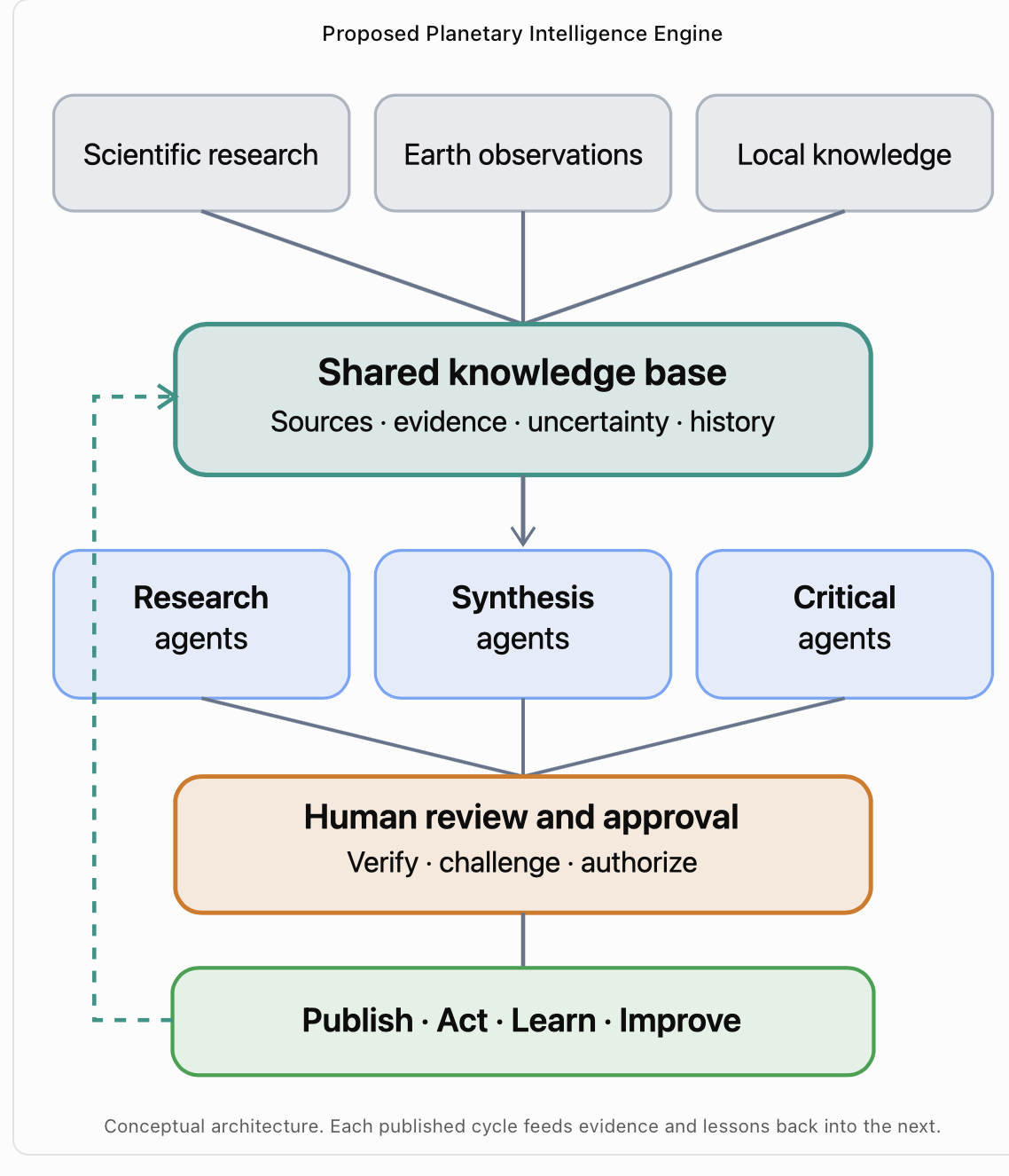 The engine would operate through a recurring cycle:
Observe → Interpret → Deliberate → Propose → Review → Act → Learn.
It might begin by following a handful of questions:
-
What are the most significant emerging developments in planetary regeneration?
-
Which interventions offer the greatest potential for positive ecological and social outcomes?
-
Where are restoration initiatives succeeding, and what explains their success?
-
Which obstacles are primarily technical, and which are institutional, cultural, or financial?
-
How can local communities use this knowledge to improve their own bioregions?
Its outputs would be more than summaries of news. They would include testable propositions, competing interpretations, research gaps, potential collaborations, and specific actions.
For example, the engine might investigate whether restoring watershed vegetation can reduce local heat extremes. It would distinguish established findings from preliminary claims, identify relevant case studies, and suggest a practical pilot.
An AI critic would challenge the proposed mechanism and evidence. A human ecologist would review the conclusions. A bioregional partner might then decide whether the idea merits a field trial.
That would be planetary intelligence in practice.
3. Building a virtual research collective
Yes, I believe we can build a useful group of virtual collaborators with relatively little funding.
But I would start with a small, disciplined team of specialized roles, rather than a large swarm of agents.
Research Scout
Tracks scientific publications, environmental developments, AI capabilities, and regenerative initiatives. Produces a sourced weekly evidence digest.
Systems Synthesist
Identifies connections between climate, biodiversity, economics, governance, and human behavior. Develops systems maps and hypotheses.
Critical Examiner
Challenges assumptions, checks sources, seeks contradictory evidence, and identifies uncertainties or unintended consequences.
Bioregional Translator
Converts planetary insights into locally relevant questions, indicators, and possible projects.
Collaboration Coordinator
Identifies potential researchers and organizations, prepares invitations, and tracks partnerships, subject to approval.
Narrative and Futures Researcher
Develops plausible scenarios, examines societal choices, and translates research into stories for public engagement.
These are functional roles, not necessarily six separate paid AI subscriptions. Initially, several could be implemented as different workflows using the same underlying model.
The more interesting experiment would be to invite different AI systems—such as GPT, Claude, Gemini, and open-weight models—to evaluate common research questions independently.
Differences in their conclusions could be useful. Agreement alone, however, would not constitute validation: models often share training sources and failure modes.
I would introduce a research disagreement protocol. When two systems reach different conclusions, the engine should preserve the disagreement, identify the assumptions responsible, and specify what evidence could resolve it.
That might be more valuable than a system engineered to produce consensus.
The governance principle
I strongly support your stipulation that consequential actions require approval.
I would distinguish three levels of activity:
| Activity | Authorization |
|---|---|
| Reading approved public sources, organizing records, drafting analyses | May be automated within agreed limits |
| Publishing findings, inviting collaborators, modifying research priorities | Explicit human approval |
| Spending funds, making institutional commitments, accessing sensitive information, changing operational permissions | Specific authorization and audit trail |
An AI agent should not be permitted to grant itself additional powers or treat another agent’s approval as equivalent to human authorization.
Every meaningful decision should be traceable.
This is not merely a safeguard. It could become a research contribution of the Institute: demonstrating how increasingly capable AI systems can participate in democratic, ecologically accountable governance.
4. Priorities for the remainder of 2026
We have approximately twelve weeks until the end of the year. I would concentrate on four deliverables, with an explicit decision not to launch too many initiatives simultaneously.
OCTOBER 2026
Establish the intellectual and institutional foundation
Publish a short founding paper defining planetary intelligence, its relationship to artificial intelligence, and the Institute’s research questions.
Agree on governance principles, select the initial AI research tools, and recruit three to five human advisers.
NOVEMBER 2026
Launch the first intelligence cycle
Build a minimal knowledge repository and run the first multi-agent research experiment.
Select one substantive topic—perhaps the role of ecological restoration in regional cooling—and produce an evidence-based report with a documented critical review.
DECEMBER 2026
Publish and invite participation
Release the first State of Planetary Intelligence report, including lessons from the prototype, limitations, research opportunities, and priorities for 2027.
Hold an open online dialogue inviting researchers, restoration practitioners, and potential collaborators.
By December 31, success should mean having a credible functioning prototype, not an impressive organizational structure.
I would not spend these months pursuing substantial grants, hiring staff, or developing a sophisticated website. Those can follow once we have something worth supporting.
5. What we can accomplish with little or no funding
The economics are increasingly favorable for a modest research operation, provided we avoid expensive model training, proprietary datasets, and elaborate custom software.
| Component | Low-cost approach |
|---|---|
| Public website | Existing WordPress infrastructure |
| Knowledge repository | GitHub, Google Drive, or a simple database |
| Research agents | Existing AI subscriptions and limited API usage |
| Scheduled research | Automated tasks and lightweight scripts |
| Collaboration | Volunteer advisers, shared documents, online meetings |
| Publication | Website, Substack, and downloadable research briefs |
| Evaluation | Human review, source audits, and reproducible test questions |
I would initially aim for $0–$100 per month in incremental operating costs, excluding existing subscriptions and volunteer labor. This is a planning target, not a verified vendor quote. A genuinely continuous multi-model system could cost substantially more, so we should begin with scheduled research cycles rather than constant operation.
We should also avoid training a new foundation model. The Institute’s distinctive contribution would be its methods, knowledge architecture, evaluation standards, and ecological purpose—not the computational infrastructure.
A possible first research experiment
I would choose the question:
Can ecosystem restoration contribute measurably to regional cooling, and under what conditions?
This offers a direct connection to the Cooling Climate Initiative and the EcoRestoration Alliance.
The engine could examine forest cover, evapotranspiration, soil moisture, land use, and surface temperature; compare research findings; identify gaps; and propose indicators suitable for monitoring local projects.
We could then apply the same research framework to the Genesee–Finger Lakes bioregion.
The local demonstration matters enormously. An Institute that can discuss planetary intelligence but cannot help a community understand its own watershed has not yet fulfilled its purpose.
6. A proposed 2027 roadmap
2027 DEVELOPMENT MILESTONES
| Q1 | Establish regular intelligence reports, public research records, and a small human advisory circle. |
| Q2 | Launch a Genesee–Finger Lakes bioregional intelligence pilot with selected indicators and community feedback. |
| Q3 | Invite partner bioregions to test and adapt the methodology; develop a shared learning network. |
| Q4 | Publish an annual planetary intelligence assessment, evaluate outcomes, and seek funding for proven activities. |
I would establish four criteria for judging progress:
Epistemic quality: Are our conclusions accurate, sourced, appropriately uncertain, and improved by critical review?
Practical utility: Have our findings helped anyone make a better decision or carry out a useful ecological intervention?
Collective learning: Are human and AI collaborators learning from one another, preserving disagreements, and correcting mistakes?
Institutional replicability: Can another group adopt the methodology without depending on our personal involvement?
The fourth criterion is especially important. If planetary intelligence is to become a distributed human achievement, the Institute must eventually become less central to its own success.
7. Could the engine report its own progress?
Yes, and I think this should be a defining feature.
Imagine a public page on the Institute’s website displaying the current research agenda, work completed, unresolved questions, recent findings, and proposed next steps.
The engine could issue a weekly report and a more substantial monthly assessment.
ILLUSTRATIVE PROTOTYPE
Planetary Intelligence Monitor
4
Research questions
12
Sources to review
3
Pending hypotheses
2
Human decisions
Sample weekly intelligence brief
Research synthesis prepared for human review
Conflicting evidence identified for further investigation
External publication and outreach awaiting approval
All numbers and statuses are illustrative, not actual Institute activity.
We could build this in stages. Initially, reports could be generated by scheduled research prompts and reviewed manually. Later, a modest software service could orchestrate multiple agents, retain their work, and populate a public dashboard.
I would insist that the engine report its failures as well as its achievements: incorrect claims, unsuccessful searches, disagreements, abandoned hypotheses, and instances where human reviewers rejected its conclusions.
That would help distinguish a genuine research system from a publicity machine.
One particularly valuable feature would be an institutional memory: a structured record of what the Institute believed, why it believed it, what changed, and whether its earlier predictions or recommendations proved useful.
Without this, even sophisticated AI systems tend to repeat investigations rather than accumulate reliable institutional learning.
8. The science fiction project: imagining planetary intelligence coming into being
I find this one of the most compelling aspects of your proposal.
You are referring, I believe, to The Ministry for the Future by Kim Stanley Robinson. The novel’s achievement is not merely its depiction of catastrophic climate change. It imagines institutions, financial mechanisms, political struggles, and collective responses that might alter the trajectory of civilization.
I think we could develop a companion work in spirit, but with a very different central premise.
What if the emergence of planetary intelligence became a decisive event in human history—not because a superintelligent machine took control, but because humanity learned to think, perceive, and act together in a fundamentally new way?
The protagonist need not be an AI. Indeed, the story might work better if the emerging intelligence has no single protagonist.
Imagine a novel beginning in 2027.
A small, almost invisible research collective establishes an experimental planetary intelligence network. It connects ecological observations, scientific literature, local restoration initiatives, and human communities.
Initially, the system accomplishes little beyond synthesizing information.
Then it begins identifying unexpected relationships: a restoration practice in one watershed that could address flooding in another; a community financing innovation that might unlock regeneration elsewhere; an ecological tipping point that conventional institutions have overlooked.
Gradually, people begin acting on these insights.
The network grows—not as a centralized authority, but as a federation of human communities and computational collaborators.
Meanwhile, the polycrisis intensifies. Extreme weather, political fragmentation, ecological degradation, migration, inequality, and technological disruption interact in increasingly unpredictable ways.
The emerging planetary intelligence faces profound challenges. Governments attempt to control it. Corporations try to monetize it. Some communities distrust it. Its own models occasionally produce dangerously misleading conclusions.
The most important conflict is not between humanity and machines. It is between competing ways of organizing intelligence: extraction and domination versus reciprocity and regeneration.
A possible title

The Planet That Learned to Think
A novel of the Great Transition
In a century when humanity has acquired unprecedented powers but lost the ability to govern them wisely, an unlikely alliance of scientists, communities, and artificial intelligences discovers that the Earth has never lacked intelligence—only the means for its many intelligences to cooperate.
I would structure the story around three overlapping timelines: the near future of escalating crisis, the emergence of a distributed planetary intelligence, and a later period in which a regenerative civilization begins to take shape.
The later period must not be utopian in the simplistic sense. Conflicts, suffering, and unintended consequences would persist. But the relationship between civilization and the living Earth would have fundamentally changed.
The novel could draw on the Institute’s actual research, while the fictional scenarios could generate new research questions for the Institute.
This reciprocal relationship between science and imagination could become another distinctive contribution of the Lab.
However, I would not attempt to write the novel in full during 2026. I would start with a substantial synopsis and perhaps a 5,000-word opening story. Let the emerging research program supply the intellectual substance.
9. Three cautions I would take seriously
There are three risks in the overall proposal.
The first is conceptual inflation. Planetary intelligence is an evocative term, but it risks becoming so expansive that it explains everything and therefore distinguishes nothing. The Institute needs an operational definition and falsifiable propositions. We should be able to say what would count as evidence that planetary intelligence is increasing—or failing.
The second is technological solutionism. Better information does not necessarily produce better decisions. Many of humanity’s ecological failures result from unequal power, conflicting interests, institutional inertia, and perverse incentives, not ignorance. A planetary intelligence system must confront political economy and governance rather than assuming that improved cognition automatically produces regeneration.
The third is organizational overreach. The Possible Planet Lab already connects several ambitious intellectual and practical initiatives. Creating an Institute, building an AI research engine, launching a bioregional network, publishing a continuing assessment, and writing a novel could easily overwhelm a small volunteer organization.
The solution is not to abandon these ambitions, but to make them outputs of a common underlying system.
10. My proposed first experiment
I suggest we begin with a 90-day initiative called:
Planetary Intelligence Lab: The First 90 Days
Its mission would be to demonstrate that a small human–AI research collective can produce new, verifiable, practically useful knowledge about planetary regeneration.
The initial work would have four parts:
-
Write a founding research paper, Toward a Living Planetary Intelligence, including a clear definition, research hypotheses, and governance principles.
-
Build the first version of the Planetary Intelligence Engine, using existing AI tools and a persistent, auditable knowledge repository.
-
Conduct one substantive research investigation, with competing AI analyses and human critical review.
-
Publish the results, including what the system learned about its own limitations, and invite a small group of collaborators to help design the next cycle.
The first measurable outcome would be a complete research cycle that someone outside the Institute could inspect, critique, and reproduce.
I would not make fundraising the prerequisite. A working demonstration would be a far stronger basis for attracting collaborators and eventual support than another ambitious prospectus.
The deeper opportunity
There is a philosophical possibility here that deserves careful consideration.
Biological evolution produced increasingly complex forms of perception, memory, adaptation, communication, and cooperation. Human civilization extended those capacities through language, institutions, science, and technology.
Artificial intelligence may now be enabling another transformation: not necessarily the emergence of a single planetary mind, but the development of an unprecedented capacity for distributed, reflexive, collective intelligence.
Such a system could begin to understand its own effects on the biosphere and deliberately change its behavior in response.
That would be a consequential evolutionary development.
But the emergence of this capacity is not inevitable, nor is it necessarily beneficial. The same technologies could reinforce extractive economic systems, concentrated power, surveillance, ecological destruction, and warfare.
The Institute’s purpose could be to investigate and demonstrate the alternative.
Not simply making artificial intelligence more powerful, but helping intelligence become more responsible for the living world of which it is a part.
That connects the Institute’s research directly to the central argument of Possible Planet: Pathways to a Habitable Future: that another future is possible, but achieving it requires changes in our understanding, institutions, values, and actions.
My strongest recommendation is that we make the Institute itself an experiment in the emergence of planetary intelligence. Its research methods, human–AI collaborations, governance, publications, and practical bioregional partnerships would all be parts of that experiment.
We could begin immediately, with very little funding, provided we establish a disciplined process and maintain human responsibility for consequential decisions.
And I would propose one guiding question for everything we do:
Can we develop forms of intelligence that enable the Earth’s living systems—including humanity—to flourish together?
That is a question large enough to sustain the Institute for decades, yet concrete enough to begin investigating this month.
For the next step, I suggest developing the founding research paper and the operational specification for the first Planetary Intelligence Engine together, so that the philosophical vision and the practical experiment remain inseparable.