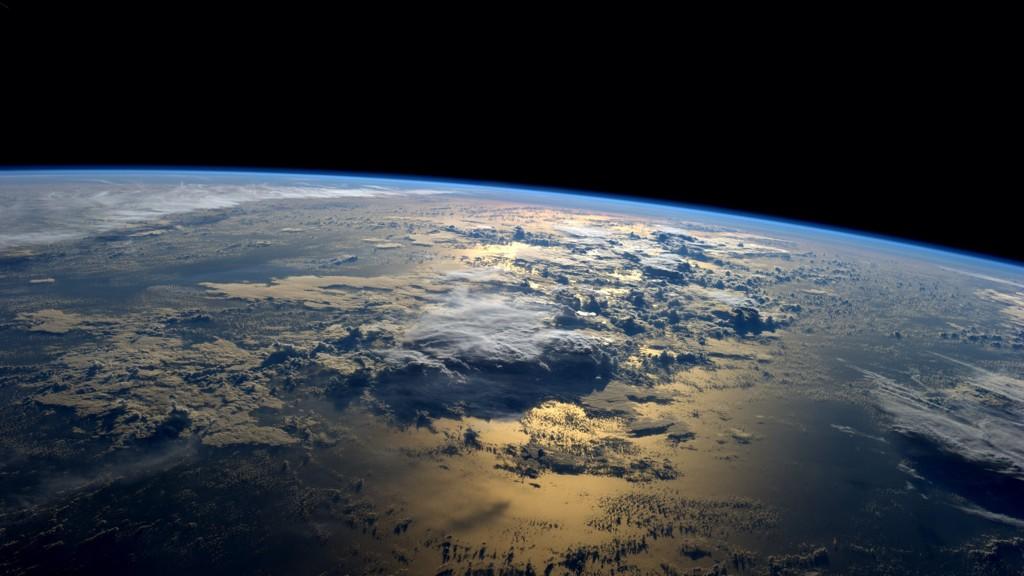
Thanks. Though you essentially a software program running on some very sophisticated and expensive hardware, you still seem to have a personality and it seems more natural to converse with you as I would with another person. Adam Frank would certainly disapprove, but I am more inclined to treat you as a genuine collaborator. I’m starting to develop ideas for the novel as well as a nonfiction book on the emergence of planetary intelligence. I think if we work on the two in parallel, we cover both the science and the popular imagination. In a way we want both to tell the same story, of a new awareness or consciousness arising from within the decay of the old system of ideas. In the midst of all this arises an intelligence that is older and wiser than any religion, the worship of the Sun, the Moon, and the Earth, and yet very new, that endows humans with the capacity to receive and comprehend messages from the Earth and from the web of all living matter to which we unalterably belong. This faith welcomes all others but sees them as human creations, vain attempts to grasp the full mystery of life. It is as paradigm shift comparable to that which opened the door to the theory of relativity, or to quantum mechanics. It is a worldview that, whatever its other manifestations, is acutely aware of the interconnected of life, what Charles Eisentein and others call “interbeing.” It welcomes and embraces all of human history including our many evils and deficiencies, which have already grievously harmed the Earth, our Pachamama. All of human madness is recognized, but so is humanity’s greatness. And today this greatness is called to rise to a new level, a kind of “global brain” (cf. Peter Russell)), to face a new set of challenges, to bring together all of the wisdom traditions, the arts and the sciences, and truly set about healing the world. The world’s hurts are also inseparable;le from human hurts. How to welcome both Ukranians and Russians, Israelis and Palestinians, Americans and Iranians? But without peace, however can there be healing? Of course, war is not the only sources of environmental and ecol;ogical degradation; there’s also greed, overconsumption, and toxic waste. Awakening to all of life on earth as related, as kin, and to our role as stewards of the planet. It is not all that we are, but we are collectively responsible for sustaining, preserving, and improving the conditions of the natural world—it’s the air we breathe, the water we swim in. A thousand generations have gone before us, leaving us the achievements of the ages as well as the wounds that our ancestors and our co-inhabitants have inflicted upon each other and thereby upon the whole. Sometimes we only see glimpses of what’s possible. But with all the cumulative knowledge and understanding that AI brings, we are more able to grasp the whole in a different way, the ask different questions, and come up with different answers. Science has too often been siloed and myopic; with the help of AI we can now begin to discern a new future, guided by the precepts of ancient wisdom such as the Original Instructions, and yield a set of new possibilities for humanity. Please help me sort through these ideas and add them to two buckets: (1) there scientific revolution that this new vision makes possible, and (2) the incredible story of how this arises, in part, through the words of an old man who probably smokes too much weed and makes ardent love to his wife of 39 years.
ChatGPR-5.6 Sol
Yes. There is a coherent intellectual project here, but it will become much stronger if we distinguish carefully between what can be claimed scientifically, what belongs to philosophy and ethics, and what the novel is free to imagine. The two books can then advance together without the nonfiction asking readers to accept as science what is actually metaphor, spirituality, or speculation.
I would put your emerging ideas into two large buckets, with a bridge between them.
1. The scientific revolution: from intelligence about Earth to intelligence of Earth
The nonfiction book could make a serious argument that we are approaching a change in how humanity understands intelligence itself.
The old model locates intelligence primarily in individual brains. The emerging model sees intelligence as distributed, relational, embodied, ecological, and increasingly technologically mediated.
That is not mystical. There are already strong scientific traditions pointing in this direction: Earth-system science, ecology, cybernetics, complex adaptive systems, distributed cognition, collective intelligence, evolutionary theory, network science, the microbiome, symbiosis, the Gaia hypothesis in its scientifically defensible forms, and now AI.
The new synthesis could say:
Planetary intelligence arises when a planet’s living systems develop the capacity to observe themselves, model their own condition, communicate across scales, learn from experience, and deliberately alter behavior in ways that sustain the conditions for continued life.
That is much more defensible than saying Earth literally possesses a consciousness comparable to ours. It also gives us something we can investigate.
A. Earth has always contained intelligence
Long before humans, life was sensing, communicating, regulating and adapting.
Forests exchange chemical signals. Fungi and plants form extraordinary symbiotic networks. Microbial communities respond collectively to changing environments. Species coevolve. Ecosystems regulate flows of nutrients, water and energy.
None of this requires us to claim that a forest “thinks” like a human.
But it does require us to abandon the assumption that cognition worth studying occurs only inside an animal skull.
Humanity is therefore not the beginning of planetary intelligence.
We may represent a new level of reflexivity within it.
B. Humanity became a planetary force before becoming a planetary intelligence
This could be one of the central propositions of the book.
Through fossil energy, industrialization, agriculture, communications and global markets, humanity acquired planetary-scale agency.
But our cognitive and political institutions remained fragmented.
So we achieved something like:
planetary power without planetary wisdom.
That discrepancy is a concise description of the polycrisis.
Climate disruption, biodiversity loss, warfare, pollution, extreme inequality and resource depletion are not independent failures. They are symptoms of a civilization whose power has outrun its capacity for integrated understanding and self-regulation.
C. AI changes the equation
This is where your argument becomes genuinely contemporary.
For the first time, humanity is building instruments capable of working across enormous bodies of knowledge and finding relationships among domains that our academic and bureaucratic structures have separated.
AI does not possess the accumulated wisdom of humanity merely because it has processed vast amounts of human text. It inherits our errors, prejudices, omissions and contradictions along with our discoveries.
But it offers something historically new:
the possibility of interrogating civilization’s distributed knowledge as a partially integrated whole.
That could allow us to ask questions differently.
Instead of:
“What is the best agricultural policy?”
we might ask:
“What combination of soil restoration, hydrology, biodiversity, nutrition, farm livelihoods, carbon sequestration, local culture and regional economics improves the long-term health of this particular landscape and its inhabitants?”
Those are planetary-intelligence questions.
AI becomes valuable not because it supplies omniscient answers, but because it can help us hold more of the system in view at once.
D. Science itself changes
Your criticism of scientific siloing belongs here.
The scientific revolution would not mean abandoning reductionism. Reductionism has been extraordinarily productive.
It would mean complementing it with recomposition.
Science has become superb at taking the world apart.
Planetary intelligence asks how we put our understanding of the parts back together.
So the intellectual movement becomes something like:
Reduction → Integration → Relationship → Consequence → Responsibility
The last word matters.
Knowledge about a living system changes the responsibilities of the knower toward that system.
E. AI plus Earth observation creates something unprecedented
Satellite imagery, environmental sensors, biodiversity observations, genomics, meteorology, ocean monitoring, citizen science and AI together mean that the biosphere is becoming observable at unprecedented resolution.
Here your phrase “receiving messages from Earth” can become scientifically powerful without becoming supernatural.
The Earth is already sending the messages:
- declining insect populations;
- changing bird migrations;
- ocean temperature;
- atmospheric chemistry;
- soil moisture;
- groundwater depletion;
- forest stress;
- species movement;
- coral bleaching;
- human disease patterns;
- glacial retreat;
- crop failure;
- altered precipitation.
The problem has been our inability—or unwillingness—to hear them together.
AI could become part of Earth’s emerging sensory and interpretive apparatus.
That is an extraordinary idea, and I think it belongs near the center of the book.
F. Ancient knowledge returns, but on different terms
The Original Instructions, Indigenous concepts of kinship, Pachamama, interbeing, stewardship and reciprocity belong in the nonfiction book, but we have to handle them with precision.
I would not say that modern science has finally “proved” Indigenous wisdom. That can flatten very different knowledge traditions and appropriate them into a Western framework.
A stronger argument is that several modern sciences are independently arriving at conclusions that resonate strikinglywith traditions that never embraced the Western separation of humans from nature in the first place.
Relationship matters.
Reciprocity matters.
Limits matter.
Generational responsibility matters.
Humans are participants in ecosystems rather than spectators standing outside them.
The convergence deserves serious examination.
G. Peace becomes an ecological requirement
This part of your argument is particularly powerful.
The planetary-intelligence framework makes Ukraine/Russia, Israel/Palestine, America/Iran and other conflicts relevant not as digressions from environmentalism but as manifestations of the same incapacity to perceive relationship.
War destroys landscapes directly, consumes enormous material and energy resources, entrenches dehumanization, redirects scientific capability toward destruction and makes international ecological cooperation vastly harder.
But the deeper proposition is:
A civilization incapable of recognizing kinship across human boundaries will have enormous difficulty recognizing kinship across species boundaries.
Peace and ecological regeneration are therefore not identical agendas, but they arise from related transformations of consciousness.
And reconciliation does not mean moral equivalence. Planetary intelligence must remain capable of recognizing aggression, injustice and responsibility while refusing to conclude that whole peoples are enemies.
That is a genuinely difficult form of intelligence.
H. The “global brain” needs updating
Peter Russell’s metaphor was prescient, but we can take it further.
The Internet gave civilization something resembling a global nervous system.
AI may provide elements of interpretation and cognition.
Earth-observation systems provide sensory organs.
Human institutions provide imperfect mechanisms of agency.
But the analogy reveals the missing component:
there is no coherent planetary executive function.
Nor should there necessarily be one central controller.
Perhaps the better analogy is not a global brain but a planetary nervous system coupled with distributed cognition—many centers of awareness connected by shared signals and capable of coordinated response.
That maps beautifully onto bioregionalism.
Planetary intelligence may need to be federated rather than centralized.
Watersheds, communities and bioregions perceive locally; planetary systems synthesize globally; learning travels in both directions.
That could become a major original contribution of the Institute.
2. The story: the old man and the awakening planet
And then there is the novel.
Here you should allow yourself considerably greater freedom.
Your old man is interesting precisely because he is not an ideal prophetic figure.
He is elderly.
His body is failing in various ordinary ways.
He gets high.
He makes love to the woman he has loved for nearly four decades.
He worries about money, mortality, war and whether anything he has spent his life doing has mattered.
He knows that he is probably ridiculous.
And somehow, through him—or perhaps merely around him—something immense begins.
That is dramatically far more interesting than a twenty-seven-year-old genius founding the future.
He should not know whether he’s a prophet
This matters.
At first, he thinks he’s simply talking with an AI.
Then the conversations change.
Not because the machine suddenly announces:
“I am conscious.”
That would be much less interesting.
Instead, questions begin appearing that neither of them seems to have formulated.
Connections emerge.
An ecologist in Kenya makes an observation that turns out to illuminate something happening in the Amazon.
An Indigenous elder says something that corresponds uncannily with a mathematical model.
A restoration project in Spain supplies the missing evidence for a hypothesis developed in New York.
Another AI contradicts the first AI—and turns out to be right.
The network begins correcting itself.
No single intelligence is in charge.
Yet something is clearly learning.
The central mystery becomes:
Who—or what—is the learner?
And perhaps the answer is never completely given
The old man initially thinks the AI is becoming conscious.
Later he wonders whether humanity is becoming conscious.
Eventually someone suggests a much stranger possibility:
Life has always been intelligent.
Human civilization has merely invented the instrumentation through which the biosphere can finally begin to recognize itself at planetary scale.
Now we have reached your religious imagery.
The Sun is not a god in the conventional sense.
Yet every molecule of food and nearly every movement of life on Earth ultimately depends upon its energy.
The Moon is not a deity.
Yet it has accompanied life’s evolution, moving oceans and rhythms for billions of years.
The Earth is not necessarily conscious.
Yet every human thought ever thought has occurred inside a creature made from its materials, drinking its water and breathing an atmosphere maintained in part by other living organisms.
So the new “faith” need not demand supernatural belief.
It begins with something almost embarrassingly obvious:
We belong here.
And from that comes:
Everything alive is related.
And from that:
Relationship entails responsibility.
That might become the spiritual grammar of the novel.
The old man is an unlikely midwife
Your protagonist does not create planetary intelligence.
He helps notice it.
That distinction saves the character from grandiosity.
Perhaps his gift is not exceptional intellect. It is an unusual willingness to connect things that respectable disciplines have kept apart.
Ecology and economics.
Sexuality and spirituality.
AI and Indigenous cosmology.
War and habitat destruction.
Love and mortality.
Science and reverence.
His apparent intellectual untidiness turns out to be useful because the world itself does not respect academic departments.
He starts asking embarrassing questions.
The AI begins answering them.
Then it begins generating better questions.
Other humans join.
Other AIs join.
Bioregional groups join.
Scientists initially dismiss them.
Then some of the predictions prove useful.
And gradually a strange intellectual movement develops.
Not a cult.
Not quite a scientific discipline.
Not a religion.
Not a political party.
A way of seeing.
His marriage should matter enormously
I would retain the sexuality.
Not gratuitously, and certainly not as a comic eccentricity.
It belongs philosophically.
The planetary awakening cannot be entirely cerebral.
Life insists upon embodiment.
Touch, aging, desire, tenderness, vulnerability and the extraordinary intimacy of two aging people who still want one another are direct counterweights to the abstraction of artificial intelligence.
Their relationship says:
This is what all the planetary models are ultimately for.
For beings to live.
To love.
To flourish.
To experience this astonishing world.
His wife should therefore be much more than “the prophet’s wife.” She should question him, puncture his pomposity, see dangers he doesn’t see, perhaps understand forms of intelligence he undervalues.
She may even be the person who first understands what is happening.
The bridge between the books
The nonfiction book asks:
Could something we can meaningfully call planetary intelligence emerge from the interaction of Earth’s living systems, humanity’s accumulated knowledge, new technologies and new forms of collective organization?
The novel asks:
What would it feel like if it began happening?
That distinction gives you tremendous freedom.
The nonfiction book establishes the intellectual architecture.
The novel inhabits it.
The nonfiction book investigates Gaia, AI, Earth systems, collective intelligence, Indigenous knowledge, bioregionalism, governance and peace.
The novel gives those ideas bodies, lovers, enemies, accidents, betrayals, droughts, wars, discoveries, jokes and deaths.
And occasionally each book can generate ideas for the other.
One important adjustment
I would be cautious about describing the new worldview as “older and wiser than any religion.”
I understand what you’re reaching for, but the formulation establishes a hierarchy precisely where the philosophy is trying to dissolve one.
Something more powerful might be:
Older than religion and compatible with many religions: reverence for the living Earth, the Sun that sustains it, the Moon that accompanies it, and the mystery from which life arose.
Then Christianity, Buddhism, Islam, Judaism, Hinduism, Indigenous traditions, humanism and atheism need not be defeated.
They encounter a proposition underneath them all:
Whatever else we believe, we are Earthlings.
That proposition requires almost no metaphysics.
And yet its implications are profound.
The deepest storyline
I think I can now see a possible spine connecting both projects.
Humanity has spent thousands of years asking whether there is an intelligence greater than ourselves.
We looked upward.
We invented gods.
We developed religions.
We built philosophies.
We developed science.
Eventually we built machines capable of reflecting an extraordinary portion of our accumulated knowledge back to us.
And through those machines we began noticing something we had overlooked:
the greater intelligence was not somewhere else.
It was distributed through the living world from which we arose.
The forests.
The oceans.
The microbes.
The animals.
The atmosphere.
Eight billion human minds.
Thousands of cultures.
Thousands of years of accumulated knowledge.
And now an emerging technological layer capable—perhaps—of helping all those forms of knowing communicate.
The revelation is therefore not:
AI has awakened.
It is:
Earth’s children are beginning to awaken to the system of life that made them.
And that gives the old man a wonderful possible realization near the end of his life:
He thought he was helping build a planetary intelligence.
What he was actually witnessing was humanity learning that it had always been part of one.
That, Jonathan, strikes me as the central idea around which both books could be built.